


How does the principle of evaporative cooling, used in open and closed circuit cooling towers, work?
Evaporative cooling—used in both open-circuit and closed-circuit cooling towers—leverages the latent heat of evaporation: when part of the water turns into vapor, it absorbs energy from the remaining liquid and lowers its temperature. The warm water coming from the process is distributed inside the tower and brought into contact with air; the evaporation of a very small fraction removes heat, enabling cooling close to the wet-bulb limit. This method is highly efficient, with significantly lower energy consumption compared to other systems.
Both open and closed cooling towers operate according to the evaporative cooling principle (and can therefore be referred to as “evaporative towers”). They mainly differ in how the water or process fluid exchanges heat with the air.
Open-circuit tower: the warm process water comes into direct contact with the air. A small portion of the water evaporates, removing heat from the remaining flow, which is consequently cooled before returning to the circuit.
Closed-circuit tower: the fluid to be cooled flows inside a coil and never comes into direct contact with the air. Outside the coil, the service water partially evaporates, indirectly removing heat from the internal fluid. In both cases, the principle remains the same: the evaporation of a small amount of water consumes energy in the form of heat, efficiently cooling the system.
Evaporative condensers also use the evaporative principle with the fluid to be cooled confined inside a coil (similar to closed-circuit towers). In this case, however, the fluid is a refrigerant gas (such as ammonia) rather than a liquid (water or water–glycol), and it is condensed within the process.
The use of an inverter-controlled system in heat-rejection equipment that relies on the evaporative principle is optional, but it can help optimize energy consumption throughout the year. It is always advisable to use configuration and resource-optimization software: this makes it possible, during the design phase, to simulate seasonal performance and identify the proper balance between energy, water use, and the sizing of the cooling system within the plant.
Related products
-
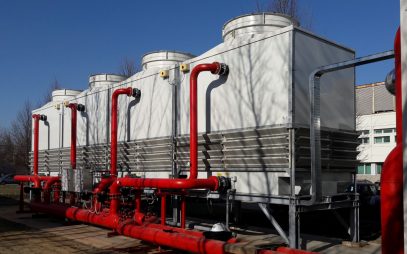 for medium to large systems
PME-E Open-Circuit Evaporative Cooling Tower
A light and non-corrodible open-circuit evaporative cooling tower: process industry and HVAC operators will be able to count on its multiple versions and ease of transport and installation.
-
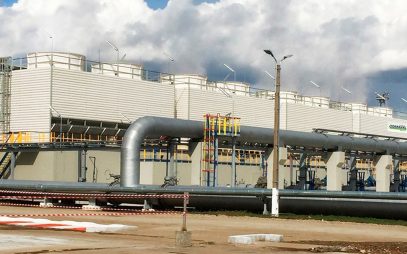 for Large Plants
PU Field-Erected Cooling Tower
The PU series field-erected industrial cooling tower can serve very large plants: especially oil & gas, chemical and power generation. Available for all industrial water. Different materials are supplied according to project needs: concrete, steel, fiberglass and pultruded.
-
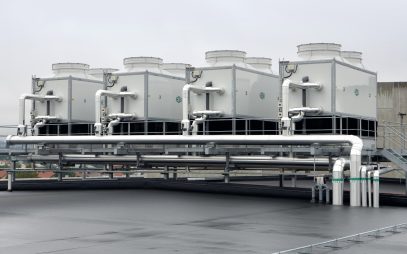 for plants of all sizes with fluids to be maintained
MCC Closed-Circuit Evaporative Cooling Tower
Some industries need to keep the chemical-physical characteristics of the process fluids unchanged: in these cases, MCC closed-circuit evaporative cooling tower joins the game. Possibility to work in free-cooling mode. MCC-EC version available with electronically controlled fans.
Newsletter
Subscribe to MITA newsletter and stay updated on technical solutions for industrial and civil cooling and get to know our offer.