


È possibile ottenere la massima efficienza energetica attraverso una serie di accorgimenti: ad esempio, dimensionando un sistema di raffreddamento in base alle esatte necessità di raffreddamento, o poco sovra-dimensionato.
Read all FaqResource and Efficiency Optimization of Cooling Systems: How to Assess It
Often the choice of a cooling technology for industrial application or HVAC does not only depend on project performance requirements.
Nowadays plant managers and engineers are more sensitive to resource optimization: a cooling system must combine performance with reduced operating costs. The growing environmental awareness is pushing towards low impact solutions.
Therefore, the comparison between different cooling technologies in terms of their sustainability is ever more important. A calculation software can now fulfill this task based on real climatic data of any given location.
MITA Efficiency
MITA Cooling Technologies has 60 years of experience, more than 35.000 installed units and a product range that includes 4 different cooling technologies: evaporative, adiabatic, mechanical and dry.
The use of different technologies has brought the need for a comparison software: MITA Efficiency.
MITA Efficiency is a tool that compares different cooling systems within the MITA range, analyzing their performances under real ambient conditions for a given location. The calculation is based upon data taken from Meteonorm, an independent platform that collects and manages representative annual data for each location in the world. Thanks to this global standard dataset and to the sophisticated calculations of MITA Efficiency software, the estimation’s accuracy and reliability is granted.
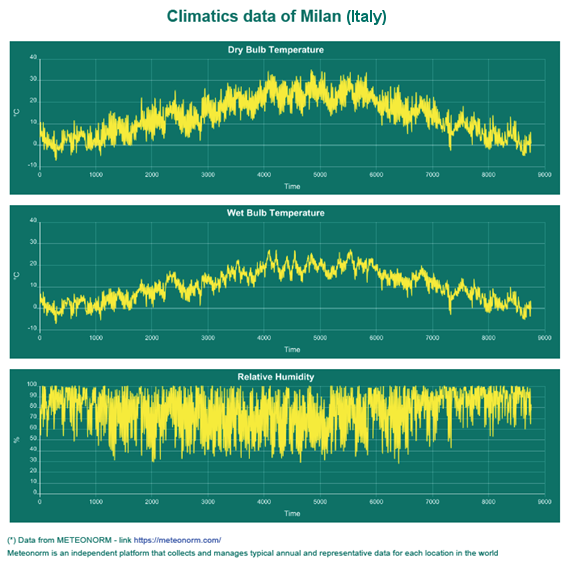
The analysis can be set according to the actual thermal loads required by the user, as they may change according to shifts or seasons.
It is an invaluable technical support, useful to show the specific advantages and optimizations achievable by choosing the most suitable cooling solution for a specific project.
>> Ask for Advice for Your Plant
Some examples:
- Electricity and water saving;
- Cooler comparison with and without VFD;
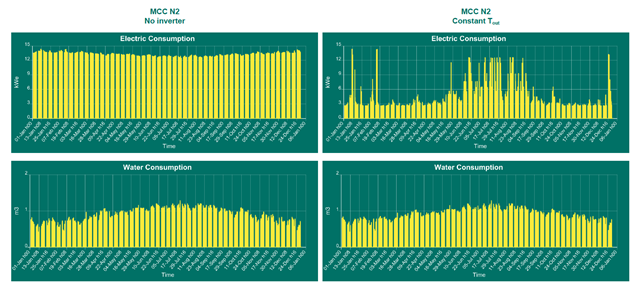
- Operating cost evaluation for units of different size within the same technological range;
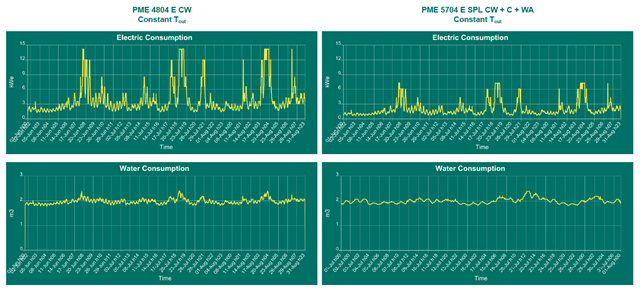
- Comparison between different cooling technologies, such as an adiabatic cooler and an evaporative system;
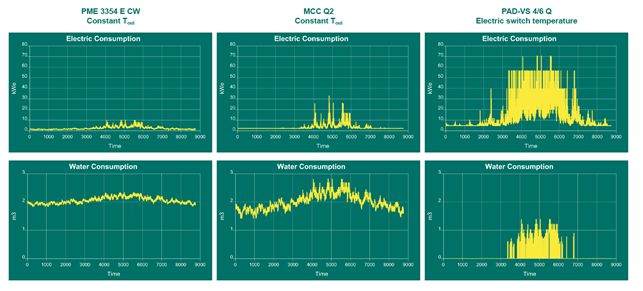
- Possibility of choosing hours of operations, considering holidays and working shifts;
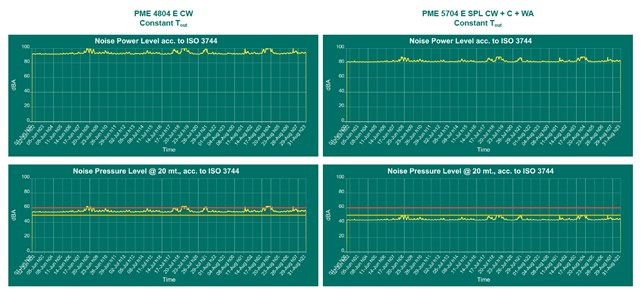
- Analysis of sound emissions between different models;
- Possibility to set different sound limits for day and night operation;
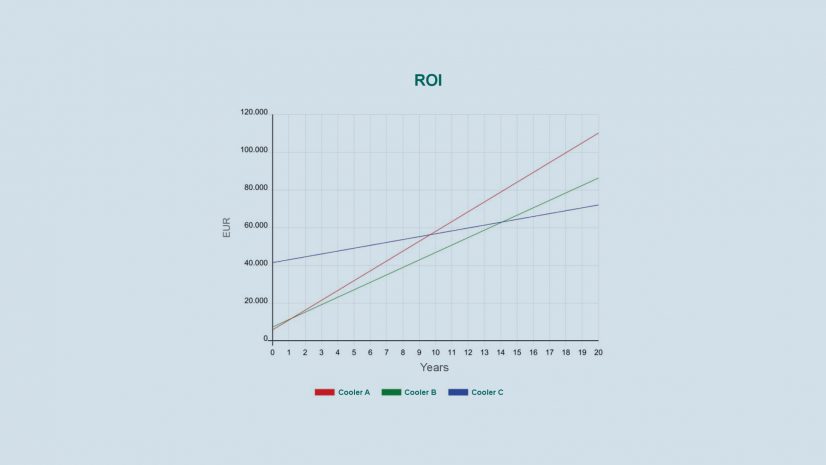
Resulting data are then used to calculate a return on investment based upon the choice of a given technology.
>> Ask for Advice for Your Plant
To sum it up, what is the most suitable industrial cooling system for our project?
The answer is well known among manufacturers of evaporative or adiabatic cooling systems: there is no best equipment in absolute terms. All other factors being equal, what matters is whether the focus is on energy efficiency, water saving, space, or sound emissions. Each type of cooler will serve the customer better in some cases while not in others.
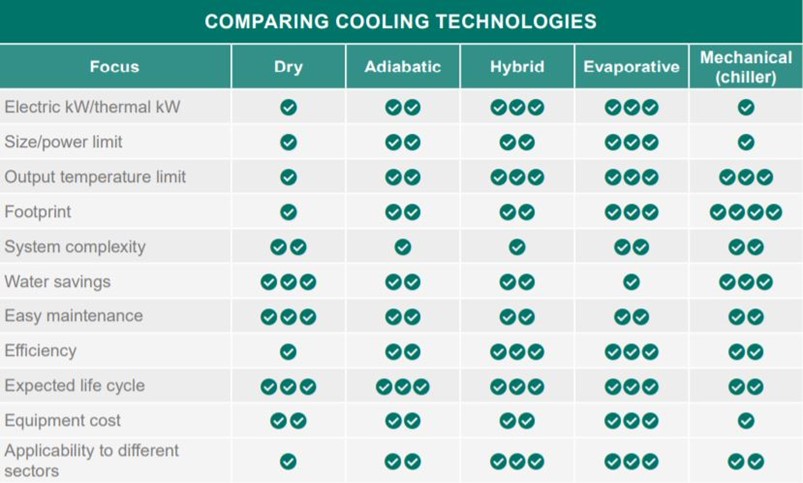
>> Find out the Compared Advantages of Evaporative and Adiabatic Systems
Even in this case, our software supports our choice for the best technology, in relation to our project.
The information provided by MITA Efficiency is very accurate and it can be represented in graphs, with the desired time interval (year, month, day) for an easy visual analysis.
A separate chapter should be dedicated to water treatment for cooling systems, an interesting topic for manufacturers and users. Good practices can be applied to ensure efficiency and reliability of an evaporative cooling tower.
>> Find out more on Water Management in Cooling Towers
Cooling System Configuration Software: Frequently Asked Questions and Expert Answers
Performance depends primarily on air temperature, relative humidity, and wet-bulb temperature, which represents the theoretical cooling limit that can be achieved. Altitude, thermal variations throughout the year, and surrounding obstructions also affect efficiency.
Read all FaqThe required cooling capacity, and the consequent sizing of the cooling system, can be calculated by an engineer experienced in industrial cooling.
Read all FaqModern evaporative coolers use automatic blowdown systems controlled by conductivity sensors, partial recovery of discharge water, and optimized make-up strategies. Adiabatic systems, on the other hand—with the proper use of sensors and PLC-based parameter settings—use water only during periods of maximum thermal load, reducing overall consumption compared to traditional cooling towers (though with some loss of efficiency). The adoption of recovery circuits also allows part of the water to be reused in any cooling system that relies on this resource.
Read all FaqChoosing the system best suited to your needs depends on several factors, mainly related to the specifics of the individual plant project to be developed: an exchange of information with a cooling consultant is often helpful.
Read all FaqThe calculation of ROI in a cooling system is a percentage indicator that shows how much economic value is generated compared to the capital invested.
Read all FaqThe Life Cycle Cost (LCC) is a calculation method used to evaluate the total cost of a cooling system over
Read all FaqThis is not something to worry about: the cooling consultant knows the right questions to ask for the selection of the best cooler, supported also by advanced software for calculation, selection, and resource optimization.
Read all FaqYes, there are calculation and sizing software: some manufacturers and cooling consultants use them in recent years to make a selection that is as tailored as possible to the needs of the individual project.
Read all FaqSelection software makes it possible to simulate thermal loads, climatic conditions, and design variables in order to determine the optimal configuration of cooling towers, dry coolers, or chillers. They provide comparative analyses of capacity, energy consumption, noise levels, and operating costs. The goal is to ensure the right balance between performance, energy efficiency, and operating expenses.
Read all FaqDuring the design phase, the use of selection and configuration software makes it possible to compare different solutions—chillers, cooling towers, adiabatic coolers, or dry coolers—by simulating their seasonal performance and heat loads. These digital tools also estimate energy and water consumption and help optimize system sizing.
Read all FaqPre-order consultation with an industrial cooling expert is often free of charge: consultant and customer can then jointly evaluate the selection of a cooler, based on specific project needs.
Read all FaqResources
Best practices
Read all Pieces of Advice by MITA Cooling TechnologiesWhat to Know
Find Out All Technical TermsTechnical Articles
Read All our Technical ArticlesNewsletter
Subscribe to MITA newsletter and stay updated on technical solutions for industrial and civil cooling and get to know our offer.