


Free cooling uses outside air to cool the process fluid without relying on the refrigeration compressor.
Read all FaqChillers for Industrial Processes
Fluid temperature far below ambient temperature: when this is necessary, mechanical cooling allowed by a chiller for industrial processes must be used.
Process Chillers: Frequently Asked Questions and Expert Answers
Subcooling is the reduction of the temperature of the refrigerant leaving the condenser.
Read all FaqSubcooling results in an increase in the cooling capacity of the system, hence electrical savings and a higher COP (coefficient of performance).
Read all Faq
Requirement: industrial fluid temperatures close to zero
When an industrial process requires a fluid to be brought well below the wet bulb temperature, evaporative and adiabatic systems are no longer sufficient.
Tell Us Your NeedsThe solution: industrial chillers
An industrial process chiller (or refrigeration unit or chiller) uses the compression and mechanical expansion of a refrigerant gas: the aim is to bring the process fluid (e.g. water or water plus glycol) below zero degrees, well below room temperature.
A chiller or compression chiller is equipped with several thermal machines: compressor, evaporator, condenser and an “expansion valve”.
Industrial Process Cooling: What to Know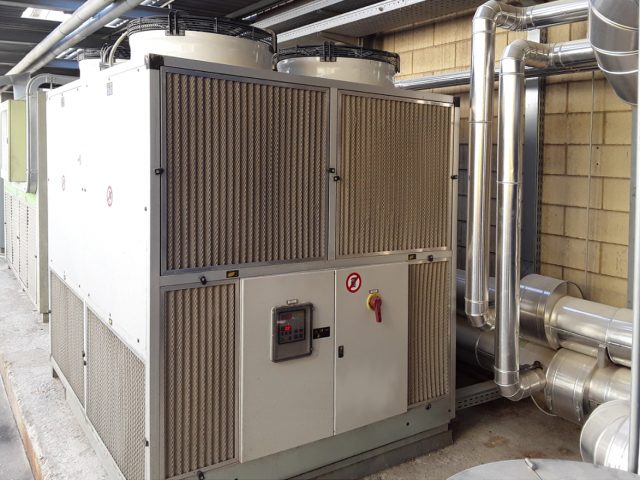
How does a chiller work?
In its various phases of operation, a chiller supplies and extracts heat from a refrigerant gas used to cool the industrial fluid. In particular, the condensing phase of the refrigerant fluid can use air: air-cooled chillers, therefore, do not consume water.
What are the components of a process chiller?
- Compressor
- Evaporator
- Condenser
- Expansion valve
MITA Solutions
-
 with axial fans
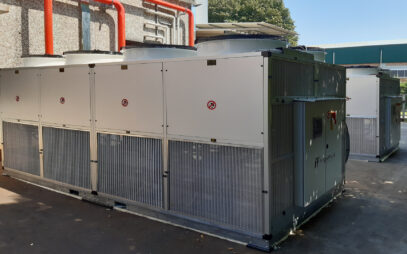
RW ax Air-Cooled Chiller
RW ax chillers are air-cooled liquid chillers with EC Brushless axial fans. Designed for energy efficiency and performance optimization, they operate at fluid outlet temperatures from 1°C to 20°C and outdoor temperatures up to 40°C.
-
 energy saving and performance optimization
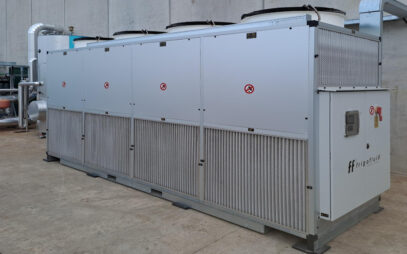
RW / EFC ax Chiller with Free-Cooling
The RW / EFC ax chiller combines energy efficiency and sustainability for industrial refrigeration with integrated free-cooling technology. The combination of operating modes, between free-cooling and compressor operation, allows up to 80 percent energy savings compared to conventional versions.
-
 environmental sustainability and performance
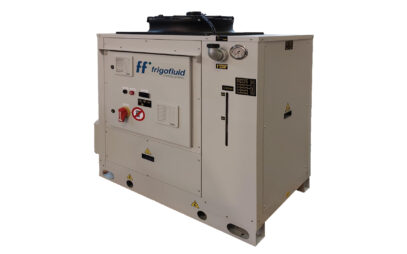
RP Green Chiller with Environmentally-Friendly Refrigerants
High energy savings, low environmental impact, compliance with stringent European regulations: green RP model chillers, with R32 or R290 refrigerant, are the industrial refrigeration solution of the future. Small footprint and provision for remote control are Frigofluid's signature to these innovative equipment.
See more technologies
Newsletter
Subscribe to MITA newsletter and stay updated on technical solutions for industrial and civil cooling and get to know our offer.