


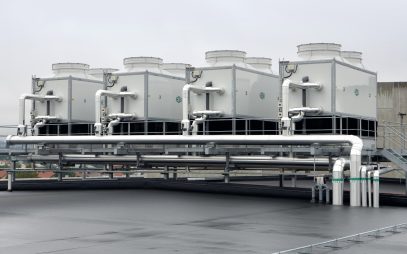
The difference between the two systems lies in the different type of circuit exploited for cooling the process fluid.
Read all FaqClosed-Circuit Cooling Towers
MITA Cooling Technologies offers closed-loop cooling towers for the United Kingdom and the EU. Closed-loop towers isolate the fluid to be cooled within a shell-and-tube heat exchanger, thereby preventing direct contact with ambient air and preserving its chemical and physical properties. This design ensures the integrity of the fluid, improves system reliability, and delivers significant operational savings by reducing chemical treatments and optimizing water and energy use.
Closed-Loop Cooling Towers: Frequently Asked Questions and Expert Answers
Safety is based on proper design, periodic maintenance, and effective water control. It is essential to prevent stagnation, ensure proper drainage, and maintain easy access to components for regular inspections.
Read all FaqBoth open-circuit and closed-circuit towers exploit a very efficient operating principle: forced evaporation of a minimum amount of water causes a lowering of the temperature of the main water mass.
Read all FaqIn direct evaporative cooling (open-circuit evaporative tower), the process water to be cooled is introduced into the tower and comes into direct contact with the outside air. The water evaporates directly into the air, removing heat and lowering its temperature — leveraging a simple natural principle: the forced evaporation of a small amount of water causes a temperature drop in the main water mass.
Read all FaqAmong in main advantages: no contamination of the primary circuit and reduced risk of freezing by being able to insert ethylene glycol into the circuit, for example.
Read all FaqYes, it is possible in the case of closed-circuit evaporative cooling towers.
Read all FaqThey vary according to type, capacity, and specific characteristics: from a few thousand euros to hundreds of thousands.
Read all FaqWet cooling towers are known for their high energy and thermal efficiency, making them an ideal solution for dissipating excess heat in air-conditioning systems and industrial processes. Thanks to the principle of evaporative cooling, these technologies can achieve very low cooling temperatures while using minimal electrical energy and water. In many applications, these lower temperatures allow the overall system to operate with reduced power consumption, directly contributing to energy savings and a lower environmental impact.
Read all FaqAll evaporative cooling systems use the evaporation of a small amount of water to lower the temperature of the larger mass of water. There are three main types of evaporative cooling systems: open circuit cooling towers, closed circuit cooling towers, and evaporative condensers.
Read all Faq1. When is it advisable to install Closed-Loop Cooling Towers?
Closed-circuit evaporative cooling towers are generally used as an alternative to open-type cooling circuits with heat exchangers in cases where the process cooling liquid (commonly water or a water-glycol mix) must maintain constant chemical and physical characteristics over time and remain uncontaminated by external agents. In fact, the fluid to be cooled circulates within the tubes of the heat exchange coil located inside the tower; the coil, in turn, is continuously wetted by the water contained in the tower basin, which is sent to a spray nozzle system via a dedicated pump. Thanks to the combined effects of the evaporation of a small portion of water and the turbulence created inside the tubes, the fluid is cooled and can then be returned to the user.
Are you a Production Manager, in Italy or Europe, dealing with sophisticated machinery that needs cooling? Or a Technical Consultant advising industrial or HVAC clients on the most reliable and low-maintenance cooling solutions? Certain risks encountered in production lines – such as suspended debris – can cause machine downtime, reduced heat exchange efficiency, and increasing water treatment costs.
Beyond the solution consisting of an open-circuit cooling tower paired with a plate heat exchanger, imagine your critical fluid completely isolated within a sealed cooling tower circuit, protected from atmospheric impurities and the complexities of direct water-air contact. This is the primary advantage of closed-circuit towers. These systems offer:
- Fluid integrity unaltered: your primary coolant remains clean, preserving its properties and protecting sensitive downstream equipment.
- Enhanced system reliability: minimal fouling and scale formation in the process circuit result in fewer unscheduled downtimes and consistent thermal performance.
- Significant operational savings: reduced requirements for chemical water treatment, lower water consumption (with proper blowdown management), and optimized energy use lower the total cost of ownership.
- Safety and compliance: a cleaner system simplifies management and supports compliance with strict health and environmental regulations.
2. How do closed-loop cooling towers work?
The physical principle behind closed-circuit towers is the same as that of open-circuit towers, but the fundamental difference lies in how this principle is applied and which water evaporates. In an open system, a small part of the process fluid itself evaporates as it comes into direct contact with the air. In a closed system, however, the process fluid flows protected inside a heat exchange coil. Cooling occurs indirectly: a secondary water circuit wets the external surface of the coil, and it is this water that evaporates, removing heat from the primary fluid without ever contaminating it.
Despite this crucial distinction, the driver of the process remains the latent heat of evaporation and the theoretical goal is the same: the air’s wet-bulb temperature. A well-sized tower, whether open or closed, can indeed cool the fluid to temperatures only 2-3°C higher than this value.
The key advantages of choosing MCC closed-circuit towers include…
- No contamination of the primary circuit: the process fluid circulates inside sealed tubes and never comes into direct contact with the ambient air. This is crucial for industries, such as food processing, where maintaining the purity and chemical-physical properties of the process fluid is fundamental.
- Reduced risk of freezing: since the process water circulates within the heat exchange coils without direct contact with the air, glycol can be added to lower its freezing point. This is particularly advantageous in colder climates.
- Simplified system design: a closed-circuit tower can replace a system that would otherwise require both an open-circuit cooling tower and a separate heat exchanger. This results in a simpler plant layout, a reduced footprint, and higher thermal efficiency.
- Free-Cooling capability: MCC and MCC-T towers can operate in free-cooling mode, using only the temperature difference with the external environment. This allows for the direct production of chilled water during shoulder seasons without activating the refrigeration unit or with a refrigeration unit at partial load.
At MITA Cooling Technologies, we act as your dedicated cooling consultant: thanks to our advanced selection software and decades of experience, we guide you toward the ideal closed-circuit cooling solution to address your specific operational challenges in the individual plant you manage.
Could MITA closed-circuit towers therefore be the right solution for you?

Glossary of Cooling Technologies
Systems and Components: Learn MoreOther names for the same system:
- closed-circuit tower or closed-type tower,
- closed-circuit evaporative tower or closed evaporative tower,
- closed-circuit tower or closed cooling tower,
- indirect tower or indirect cooling tower,
- closed-loop tower system,
- closed-loop cooler (this category also includes non-evaporative coolers that still use indirect heat exchange, such as dry coolers and adiabatic coolers),
- closed-loop evaporative cooler (a category that also includes gas condensers).
Theory of Cooling Technologies
Closed-Loop and Open-Loop: Learn More3. Which MITA Closed-Circuit Cooling Towers can you choose from?
When the purity of your process fluid is a non-negotiable requirement, the solution is a cooling circuit that protects it from all contamination.
Shared advantages of MITA closed-circuit towers: what both solutions offer. Both the standard MCC model and the modular MCC-T share a series of fundamental advantages designed to guarantee efficiency and safety. First and foremost, they keep the process fluid hydraulically separated from the ambient air, preventing contamination and allowing the addition of glycol to protect the system from freezing in colder climates. This design translates into a simpler plant layout and a reduced footprint, while offering greater thermal efficiency. Furthermore, both models can be integrated with the MITA Control System (MCS) and the IoT platform for intelligent consumption control and management in line with Industry 4.0 standards.
Key differences: to each its own application. While the core benefits are the same, the choice between the two models depends on the specific application.
- The standard MCC tower is the versatile and robust solution, ideal for a wide range of industrial applications, capable of managing power levels between approximately 80 and 3,800 kW. Its construction, featuring a solid hot-dip galvanized steel structure and fiberglass panels, makes it the ideal choice to ensure reliability and long-term durability. The selection of high-quality materials, such as non-corrosive fiberglass, minimizes maintenance and ensures resistance even in the presence of aggressive water.
- The MCC-T tower is the modular version, specifically designed for large industrial plants (oil & gas, large paper mills, the food sector) where it is necessary to manage unaltered process fluids on a large scale. Its crucial advantage is precisely its modularity: the individual components, factory pre-assembled, are easily transportable over long distances, significantly reducing shipping costs and simplifying on-site installation. Each MCC-T module can be sized to meet cooling requirements exceeding 2 MW.
The engine that powers both closed-circuit and open-circuit towers is identical: the consulting support, from custom design to service, that we offer to define the best solution together, also utilizing the proprietary MITA Cooling Simulator software. This allows for an advance analysis of management costs and optimizes the water and energy usage of your future plant.
Ask for Information
Closed-loop cooling towers: 3 reasons to choose them
Read more4. Specifications for MITA Closed-Circuit Towers
Our range of closed-circuit towers is designed with a precise objective: to ensure maximum protection of the process fluid, keeping it pure and uncontaminated. The two systems within this family share the same DNA but meet different needs: the MCC series and its modular variant, the MCC-T – both of which are perfect for the British and European markets.
Key features common to our range of closed-circuit towers include…
Sealed circuit for the process fluid: the primary coolant flows inside a high-efficiency heat exchanger (coil) without ever coming into contact with the atmosphere or the secondary cooling medium.
Versatile fluid management: suitable for water or water-glycol mixtures without risk of contamination.
Energy-saving design: high-efficiency fans and motors (with VSD/EC options) and optimized heat exchange surfaces reduce electricity consumption.
Reduced maintenance: the clean primary circuit drastically cuts the need for maintenance on the equipment being cooled.
Robust construction: top-quality non-corrosive materials (fiberglass), hot-dip galvanized steel, or stainless steel for an extended operating life.
Precision software selection: our advanced tools ensure that your closed-circuit tower is perfectly sized for maximum efficiency and cost-effectiveness.
Certain differences may lead to opting for the MCC or MCC-T system, depending on the specific requirements of the installation project.
- The MCC series is a factory-assembled, robust, and versatile solution. It is the ideal choice for a wide range of HVAC applications and industrial processes that require a reliable, high-performance, and easy-to-install solution.
- The MCC-T series, on the other hand, is the specific answer for large-scale projects. Its hallmark is modularity: it is designed in pre-assembled sections, easily transportable by container. This makes it the perfect solution for large industrial plants (for example, in the Oil & Gas or paper sectors) where logistics is a key factor, as it allows for significantly reduced transport costs and simplified on-site assembly operations.
5. Applications and Case Studies of Closed-Loop Towers
MITA closed-circuit towers are the ideal solution in numerous sectors in Italy, Europe, and worldwide. In every context, process fluid protection and operational continuity are always guaranteed as the primary, essential advantages. Here are some key sectors…
Industrial Processes: plastic injection molding, die-casting presses, furnaces, compressors, chemical reactors.
Food & Beverage: dairy plants, breweries, food processing.
Pharmaceutical: precise temperature control and fluid hygiene.
Power Generation: auxiliary cooling of generators and turbines.
Commercial HVAC: buildings, hospitals, universities.
Data Centers: server protection from contaminants.
Automotive: welding lines, painting, engine test benches.
Discover concrete examples in our Applications section and read the Case Studies to see how MITA closed-circuit towers have solved real challenges, improving efficiency and operational continuity!
MITA Case Studies Featuring Closed-Loop Towers

Cooling Technologies for a High-Quality Food Process
More than a hundred years ago it was an apple orchard: now it is one of the most important food industries in Sweden. This is the company to which MITA Cooling Technologies and CAMPreq have provided solutions-as manufacturer and process cooling consultant, respectively.
Learn More
Closed-Cooling Towers for the Rotor Dynamics Lab (University of Pisa)
MITA Cooling Technologies and technology research in academia: in 2015, we participated in the tender for the cooling system of the 2 engine test benches attached to the Rotordinamica Laboratory of the University of Pisa.
Learn More
Creta Farm cuts energy bill with Mita technology
After a devastating fire, Creta Farms decided to rebuild and install an energy-efficient solution for the production plant in Crete.
Learn MoreApplications for MITA Closed-Loop Cooling Systems
-
Food Industry
In the food industry, cooling systems play a crucial role in preserving finished product quality and ensuring business continuity. MITA Cooling Technologies’ cooling technologies, such as closed-loop evaporative towers and adiabatic dry coolers, ensure precise and consistent temperatures for delicate food processes without compromising the safety and purity of process fluids.
-
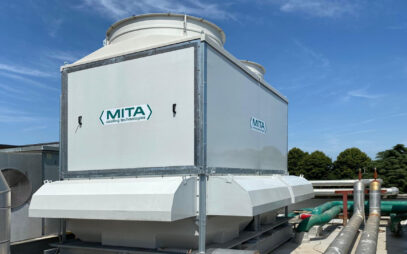
Hospitals and Healthcare
In the healthcare sector, industrial cooling is critical to ensure the proper operation of critical facilities such as HVAC systems and medical equipment. MITA Cooling Technologies offers quiet, low-maintenance solutions, such as cooling towers and dry coolers, designed for hospitals and clinics. The goal? Reliable performance, reduced operating costs and acoustic comfort.
-
Shopping Centers
The air conditioning systems in shopping centers must ensure low noise levels: the same goes for the attached coolers. Therefore, the engineering firms and plant installers are concerned with installing cooling solutions with sound-absorbing technologies, mostly evaporative. A further plus is the need to place the machine in confined spaces.
6. The advantage of working with us: a consultative approach to your cooling needs
Choosing the right closed-circuit tower requires more than matching a cooling capacity to a plant: it is necessary to understand the process, environmental conditions, energy and water costs, and long-term operational goals. This holistic approach is the added value of MITA Cooling Technologies.
Dedicated consulting: our engineers work closely with Production Managers and Technical Consultants in Italy and Europe to analyze specific needs and ensure the optimal choice.
Precision sizing: thanks to proprietary tools like MITA Cooling Simulator, we simulate the real performance of your closed-circuit system, evaluating resource usage and thermal efficiency.
Customized solutions: in addition to the standard range, we adapt designs for specific space, noise, or material requirements.
Resource optimization: our goal is to minimize life-cycle costs by optimizing energy, water, and maintenance.
Full Support: from the initial inquiry to installation and after-sales service, we remain by your side.
Partnering with MITA means relying on one of the leading manufacturers of closed-circuit towers, dedicated not just to supply, but to an engineered solution supported at every stage.
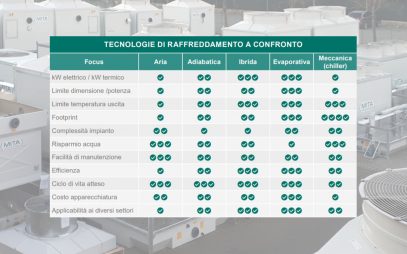
Resource Optimization and Efficiency in Industrial Cooling Systems
Read the article to learn more
Environmental and economic sustainability of each MITA closed cooling tower
- Use of water for efficient heat transfer (i.e., cooling of the process fluid).
- Low and further optimizable energy use.
- Extremely small installation spaces.
- Falls within the product categories that MITA is able to regenerate.
- Indication of “carbon footprint” from the MITA team.
Tools to help you choose
Cooling Advisors
Preliminary plant evaluation
Tailor-made design
Newsletter
Subscribe to MITA newsletter and stay updated on technical solutions for industrial and civil cooling and get to know our offer.